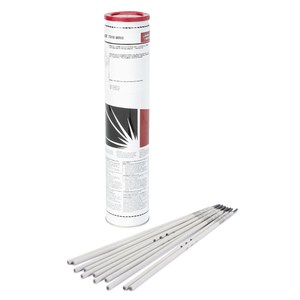
Package Price:
$95.84/4kg tubeIn stock
The Lincoln Electric 7018AC is a high-quality, low-hydrogen stick electrode designed specifically to address the arc stability challenges often encountered when welding with Alternating Current (AC) power sources. While standard E7018 electrodes are primarily optimized for Direct Current Electrode Positive (DCEP), this variant features a specialized coating formulation containing arc stabilizers that maintain ionization during the zero-crossing of the AC sine wave. This results in a smooth, consistent arc that resists extinguishing, making it an essential consumable for shops equipped with AC transformers or for applications where arc blow is a concern.
With a diameter of 2.5mm (approximately 3/32 inch), this electrode is ideal for welding thinner sections of mild and low-alloy steel while still providing the deep penetration and high tensile strength characteristic of the E7018 classification. The iron powder content in the coating increases deposition rates compared to non-iron powder electrodes, improving operational efficiency. As a low-hydrogen consumable, it produces weld deposits with excellent ductility and impact toughness, significantly reducing the risk of hydrogen-induced cracking (cold cracking) in the heat-affected zone (HAZ).
This electrode is classified as all-position, capable of producing X-ray quality welds in flat, horizontal, vertical, and overhead positions. It is particularly well-suited for structural steel fabrication, maintenance of heavy equipment, and general industrial repair where high-strength, crack-resistant welds are required. Proper storage and handling are critical; like all low-hydrogen electrodes, the 7018AC should be stored in a holding oven or hermetically sealed container to prevent moisture absorption, which can lead to porosity and hydrogen embrittlement.
| Additional Information |
|---|
| Packaging Description:4kg tube |
| AWS Spec :E7018-1, E7018 |
| Diameter:2.5mm |
| Brand:Lincoln |
| Polarity:AC/DC-, DC+ / AC |
| Position:ALL |
| Amp Range:70-110amp, 75-110amp |
| Rod Type:Stick Electrode |
| Core Material:Mild Steel |
| Coating Type:Low Hydrogen Iron Powder |
| AWS Classification:E7018-AC |
| Welding Position:All position |
| Storage Instructions:Store in a dry, controlled environment; recondition if exposed to moisture |